The Rippling Price Strategy of AWS
Published:
AWS
- Product: Cloud Computing
- New or existing: Innovated an existing product
- Disruption: Replaced upfront capital and long-term hosting commitments with metered, on-demand pricing by giving developers access to storage and computing bandwidth on-demand via API which made computing more accessible to startups and small businesses.
- Target Market: Developers, small businesses, startups
- Competitive Landscape: AWS had the $$$ infrastructure under Amazon to scale quickly, gain economies of scale which reduced their cost and then AWS passed those savings to customers via lower prices building a strong moat that warded off competition for many years.

INTRODUCTION
Pricing strategy has the power not only to influence sales for a product but to reshape an industry, industries that interact with that industry and the entire economy. Pricing is the mechanism that determines who can afford to participate in an industry, how fast they can scale and what risks they inherently take. Amazon Web Services (AWS) illuminated this by replacing upfront capital and long-term hosting commitments with metered, on-demand pricing. Businesses traded fixed expenses like data centers and physical servers for variable ones by using Amazon’s infrastructure on-demand instead of acquiring their own.
The year 2000 commenced a decade when businesses sought to get on the web as the internet reshaped how people transact, communicate and exchange information. Amazon Prime (2005) gave subscribers access to free two-day shipping on hundreds of thousands of items and the iPhone (2007) dropped the internet into every hand. Facebook created new ways to network (2006) and Google created a platform for advertising (2000). The internet created needs where they didn’t exist and businesses were harnessing digitalization for product development, marketing and new channels created by online shopping.

The problem was that for businesses to get on the web before 2006, they needed to procure extensive computing infrastructure capable of storage, networking and general computing that cost thousands of dollars upfront and thus out of reach for most businesses trying to get off the ground. They also needed to forecast storage capacity and compute power into the future to secure sufficient server equipment or else risk being ill-prepared for surges and missing business opportunities as a result. At the other extreme, overshooting compute needs led to computing infrastructure sitting idle. For firms in seasonal industries like accounting, computing was integral but only needed for a few months every year. For startups, budgets were tight and the future uncertain, so investments in servers and data centers carried a greater risk of capital gone to waste.
Then there was the issue of scaling. Scaling up to accommodate growth before cloud computing meant purchasing more servers, infrastructure, equipment and related services via painfully slow procurement processes. Amazon redefined this equation in 2006 by creating instantaneous access and scalability.
DISRUPTION
AWS first released the S3 (Simple Storage service) in March 2006 and the EC2 (Elastic Compute Cloud) shortly after. With just a credit card, developers could sign onto AWS and initiate a virtual server instance hosted by Amazon which was then charged back based on CPU, storage and bandwidth usage. Prices started at a base rate of 10 cents (USD) per hour for server time which if used continuously over an entire month would have added up to $72 and was comparable to what traditional server providers charged on a monthly basis at that time. It was even surmised (in an article on TechCrunch at the time) that the price may not have been sufficiently low to compete with traditional server providersat the time as it remained to be seen that the value of AWS was not in its continuously available monthly price but in offering an on-demand hourly rate along with the ease of launching and scaling the service.

In their book Game Changer, Jean-Manuel Izaret and Arnab Sinha champion AWS strategy for its cost leadership approach likening it to that taken by low cost airlines like Ryanair and Southwest. These airlines reframed air travel as a commodity and took aim at consumers who were priced out by legacy carriers at the time.
Similarly, AWS commoditized computing services since a CPU is a CPU, and suddenly that CPU became very accessible. By shifting to an on-demand hourly pricing model that facilitated easy scaling while keeping what the monthly cost would be level with the prevailing monthly rental price of dedicated hosting, AWS may have been taking aim at new markets. Startups with tight budgets and small businesses with little skin on their backs were now able to enter the computing space and scale up (or back down) faster than they would have with dedicated hosting providers. Mature enterprises on the other hand had much of that capital and operating infrastructure at the outset and scaling was more readily financed. By lowering the entry barriers, AWS also shifted purchasing decisions from being enterprise procurement-led to self-serve product-led thus empowering developers to make agile decisions directly for their organization. Startups no longer needed to raise thousands to buy access to servers and data centers. With AWS, they could just hit the ground running.
GARGANTUAN GROWTH

AWS immediately saw great success with over 12,000 developers signing up for S3 by the end of the day it was released and Amazon reported in their 2006 annual report that over 240,000 developers worked with AWS by the end of the first year. Amazon launched the AWS Start-up Tour in 2008 with the following announcement:
AWS’s success had ripple effects across the economy. As a Silicon Valley entrepreneur told Wired, “Infrastructure is the big guys’ most powerful asset. This levels the playing field.”
Despite the 2008 financial crisis when the economy took an across the board hit, Silicon Valley saw an impressive growth in new start-ups when it recovered. In the chart below you can see how the number of startup companies began to accelerate in 2010 similar to how it had in the 90s dot-com era. Of course a number of governmental policy initiatives and stimulus checks likely also contributed to that growth.
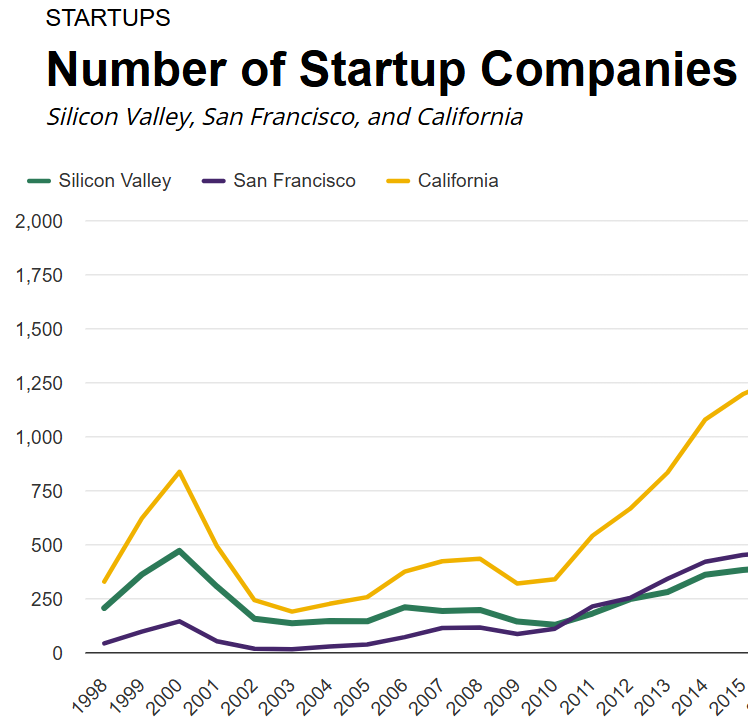
Chart from SiliconValleyIndicators.org
AIN’T NO STOPPIN US NOW
To understand the leverage AWS had over pricing to fortify its market share, it is essential to recognize the moat it built through disciplined capital management and strong economies of scale. AWS itself was born out of a pursuit for efficiency and cost reduction at Amazon. To power its own diverse business lines spanning e-commerce, logistics, streaming etc., Amazon’s computing needs were enormous and before AWS, developers across its vast ecosystem were constantly bogged down by repetitive workflows that slowed innovation. AWS streamlined those processes into a set of “primitives” and all data was made externally accessible via APIs. Amazon had thus built an internal cloud system and it then scaled that into a monetizable service.

As their customer base grew and startups under its umbrella scaled, AWS’s own infrastructure also scaled enriching not only their economies of scale but also their bargaining power in procurement. Bargaining power helps Amazon negotiate lower prices and better financing options with suppliers yielding cost savings and enhancing their fixed capital structure.
Rather than laying out billions of dollars on data center infrastructure up front before they ever earn revenue, Amazon utilizes capital leases to spread out payments over a longer period of time. This effectively aligns cash outflows with actual utilization. This also preserves cash in the short term.
This positioned AWS to offer cloud services at unbeatable prices from a strong cost leadership position. For a competitor to enter this ring offering the same CPU as AWS, they would need to have their ducks aligned in a row. Realistically that could only be another large tech firm.
By the time Microsoft and Google rolled out their own cloud computing services, AWS had built up a strategic margin buffer to lower price as the competitive landscape intensified into a full-on price war. By March 2014, AWS had lowered their prices 42 times to preserve their stake amidst the competition.
Today, a few more competitors including Alibaba have entered the cloud computing space but Amazon (28% market share) continues to lead Microsoft (21%) and Google (14%).. This space is ripe again for more disruption as AI continues to grow and take over but that deserves a separate discussion.
This is how an e-commerce giant achieved a leaps and bounds head start in cloud computing and claimed a seat at the tech giant table. While Amazon receives much gripe for how its business practices, its pricing strategy sits on a complex foundation born out of undeniable genius.